
By Abdullahi Alhassan, Kaduna
The Deputy Governor of Kaduna State, Dr. Hadiza Sabuwa Balarabe, has cautioned that sustainable national development is impossible when a country’s most productive population is undermined by drug abuse, describing the crisis as a growing epidemic that threatens Nigeria’s human capital base.
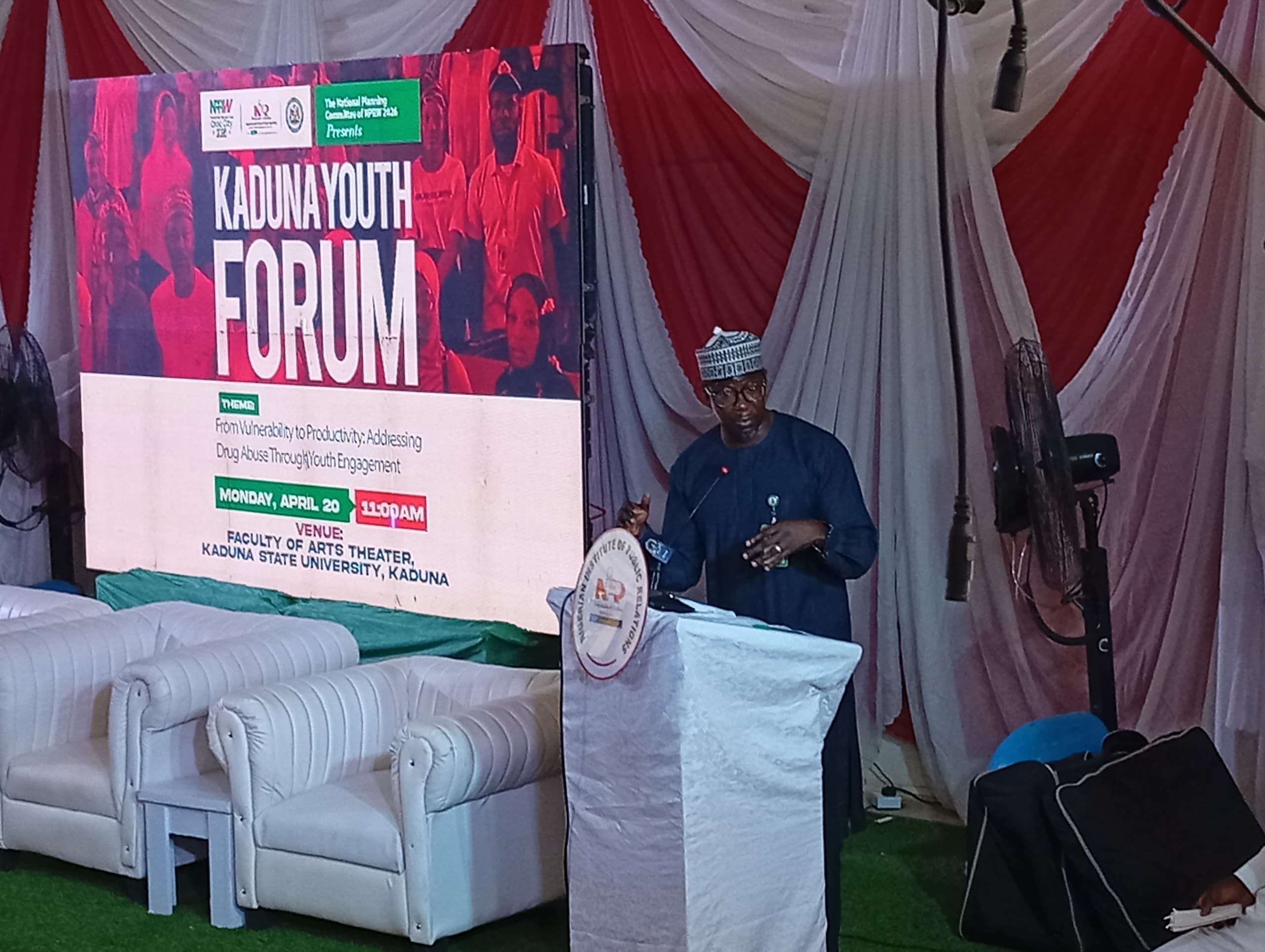
Dr. Balarabe delivered the warning on Monday while speaking at the 2026 Undergraduate Forum of the Nigerian Institute of Public Relations Week held at Kaduna State University.
She stressed the urgent need to tackle the demand side of substance abuse in order to secure the nation’s future leadership.
Citing data from the National Drug Use Survey, the deputy governor noted that approximately 14.3 million Nigerians are affected by drug abuse, nearly triple the global average.
She further revealed that the North-West region accounts for about three million users, with Kaduna State recording a prevalence rate of roughly 10 percent, translating to nearly half a million individuals.
According to her, the statistics represent real people whose lives are being disrupted, as substance abuse erodes mental clarity, depletes financial resources, damages relationships, and impairs moral judgment.
She added that the social consequences often manifest in strained families and long-term economic hardship.
Dr. Balarabe also linked drug abuse to rising insecurity, stating that law enforcement findings indicate a strong connection between substance use and crimes such as
kidnapping, banditry, and terrorism. She warned that the long-term effect is a steady depletion of the nation’s intellectual and productive capacity.
Reflecting on her own academic journey, she recalled that she and other dignitaries once faced similar pressures as students, noting that many promising peers succumbed to substance use and never fulfilled their potential.
She urged students to resist peer influence and avoid choices that could permanently derail their futures.
Commending the Kaduna State Government’s proactive response, the deputy governor highlighted the establishment of the Kaduna State Substance Abuse and Mental Health Services Agency (KADSAMHSA), describing it as a pioneering institution focused on prevention, treatment, and rehabilitation.
She noted that the initiative has received recognition from the United Nations Office on Drugs and Crime as a model framework for addressing drug abuse.
Dr. Balarabe emphasized that the state’s approach prioritizes early intervention and support systems designed to prevent young people from falling into addiction, while also helping those affected to recover and reintegrate into society.
Addressing the students directly, she encouraged them to embrace discipline and productivity, urging them to reject the misconception that substance use enhances performance or social appeal.
She challenged them to define success through clarity of mind and purposeful engagement.
In his keynote address, the Director General of KADSAMHSA, Mr. Joseph O. Ike, underscored the need for evidence-based strategies in combating drug abuse.
He noted that traditional awareness campaigns have proven insufficient, advocating instead for targeted interventions that address underlying risk factors.
Mr. Ike explained that vulnerability among young adults, particularly those aged 18 to 25, is influenced by a combination of biological development, environmental pressures, and social dynamics.
He stressed that these factors should be addressed through structured support systems rather than moral judgment.
He further outlined the agency’s integrated approach, which promotes mental health services within primary healthcare and educational institutions, ensuring accessibility and early detection of risk indicators.
Highlighting ongoing innovations, Mr. Ike referenced the Kaduna State Child Amplified Prevention System (KdCHAMPS), a data-driven initiative designed to identify early warning signs such as academic decline, social isolation, and unresolved trauma.
He called on Kaduna State University to adopt a comprehensive, three-tier prevention strategy encompassing universal, selective, and targeted interventions to safeguard students.
Concluding, Mr. Ike emphasized that Kaduna’s evolving framework represents a shift toward science-based, compassionate care, aimed at building a resilient and productive generation capable of driving the state’s and the nation’s future development.