By Abdullahi Alhassan, Kaduna
For a community with a painful history of violence, the road to peace in Kasuwan Magani took an unusual route on Monday — through traditional food, communal work and games.
Residents of the Kaduna State community, comprising Christians and Muslims, gathered to revive cultural practices once regarded as an ordinary part of communal life as they marked the International Day of Peace.
The programme was organised by the Interfaith Mediation Centre (IMC), with support from the German Embassy in Abuja, as part of efforts to rebuild relationships and restore trust among residents affected by years of communal tensions.
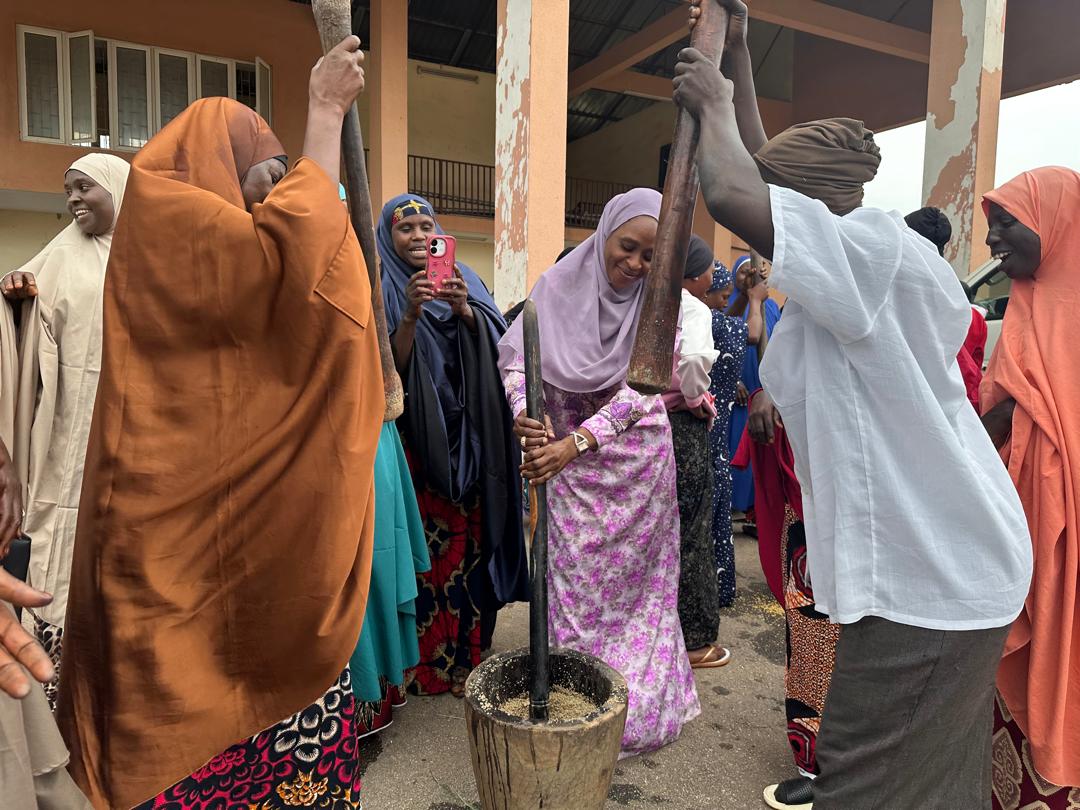
Participants cooked traditional meals together, pounded and ground guinea corn and engaged in traditional games, creating opportunities for people from different religious backgrounds to interact outside the divisions that have often defined the community.
Kasuwan Magani, a prominent commercial centre populated by people of different faiths and ethnic backgrounds, has experienced violent conflicts in the past, with lives lost, businesses disrupted and relationships fractured.
IMC said this year’s focus on culture and women was informed by the need to reconnect residents with traditions capable of promoting unity and strengthening families.
Speaking at the event, IMC Co-Executive Director, Mr. Samson Auta, said sustainable development could only thrive where peace and mutual understanding exist.
“If there is peace, there can be development. If there is interaction, there will be understanding,” Auta said.
He urged residents to look beyond religious differences and recognise their shared humanity.
“We should look at ourselves as humanity. In humanity, we need to cherish and share love among our brothers and women and the children that we have,” he added.
Auta also expressed concern that changing lifestyles and increased reliance on technology were gradually distancing younger people from their cultural heritage.
“People are not connected to their history, people are not connected to their culture,” he said, stressing the need to deliberately preserve indigenous traditions.
“We need to revisit this culture to teach our younger ones so that we just don’t lose our identity. Because when we lose our identity, we don’t know where we are.”
The peace activities are also being replicated in Zones 1 and 3 of Kasuwan Magani, according to the organisers, as part of efforts to sustain community engagement beyond the International Day of Peace.
Community leader, Jonathan Peter, said the return to traditional practices was designed to remind younger residents of a period when communal life was less divided along religious lines.
Peter argued that while formal education remains important, communities must also preserve indigenous values that promote togetherness.
He identified women as particularly important to the peacebuilding process, citing their role in raising children and maintaining family relationships.
“Women are critical to child upbringing and to achieving lasting peace,” he said.
Peter called for greater involvement of women in peacebuilding initiatives and appealed to the Federal Government to take steps capable of rebuilding public trust.
He also urged the Christian Association of Nigeria (CAN) and Jama’atu Nasril Islam (JNI) to strengthen cooperation in the interest of peaceful coexistence.
According to him, the search for peace should begin with the recognition that humanity transcends religious identity.
“Humanity comes before any religion,” Peter said.
He further called for greater recognition of traditional institutions, arguing that traditional rulers have an important role to play because their influence cuts across political, religious and ethnic boundaries.
“Unlike religious bodies that operate within limited mandates, traditional institutions have no boundaries and remain rooted in the core purpose of uniting people,” he said.
For some residents, however, the significance of the gathering went beyond the speeches.
Miss Gift Jerry, a community member, urged young people to study the way previous generations lived and interacted with one another.
“My call to young ones is for us to reflect on what our olden days parents were doing, because there was no segregation between Christian and Muslim,” she said.
“They always do things together, they play together, they come together as one. When we see what our parents have been doing before, we reflect, then we will be able to follow their steps and do more.”
Organisers said the initiative forms part of continuing efforts to heal old wounds in Kasuwan Magani and strengthen peaceful coexistence by reconnecting residents with cultural values that once brought the community together.
In Kasuwan Magani, Monday’s commemoration offered a practical reminder that rebuilding trust can begin with simple acts of togetherness, sharing food, reviving traditions and creating spaces where neighbours can meet again as one community.