By Kenneth Orusi, Managing Editor
The Federal Government has approved an 85 per cent increase in the registration fee for the Senior School Certificate Examination (SSCE), raising the cost from ₦27,000 to ₦50,000 per candidate with effect from 2027.
The development, which has already sparked widespread concern among parents, guardians and education stakeholders, comes amid worsening economic conditions, with many Nigerians battling soaring inflation, high food prices, rising transportation costs and declining purchasing power.
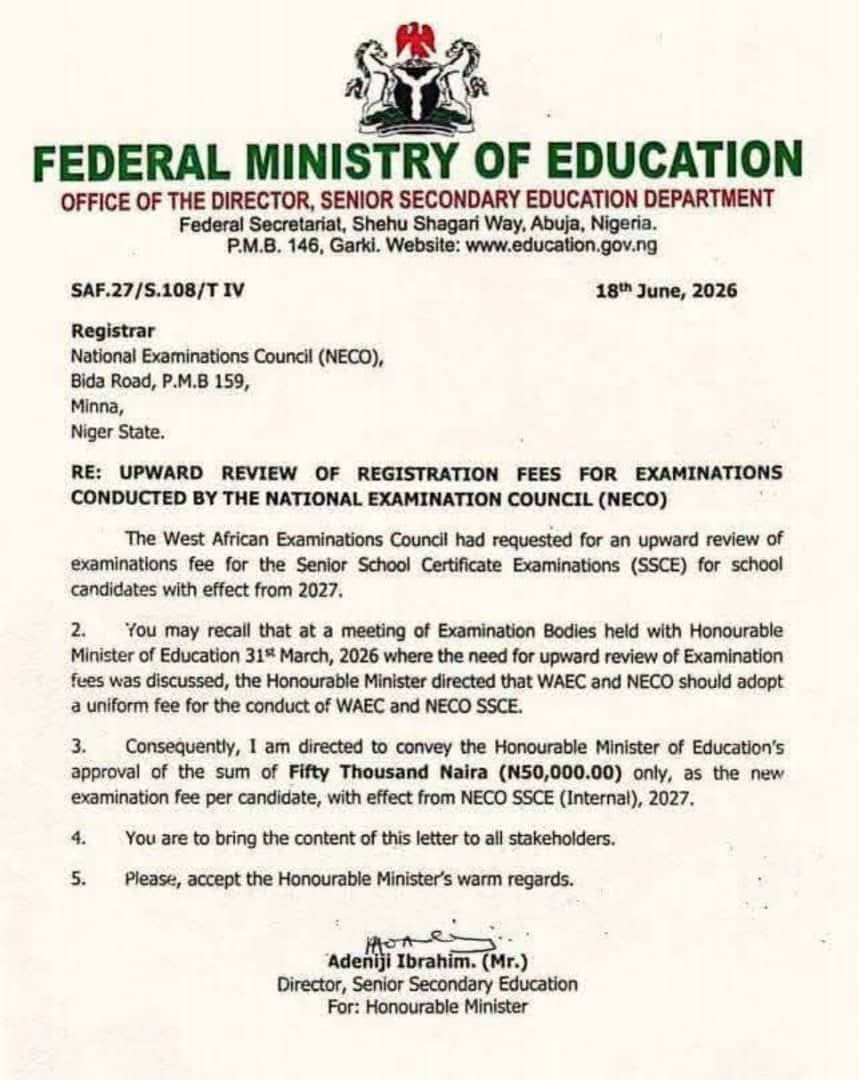
The approval was conveyed in a letter dated June 18, 2026, issued by the Federal Ministry of Education, Office of the Director, Senior Secondary Education Department, and addressed to the Registrar of the National Examinations Council (NECO).
The letter, signed by the Director of Senior Secondary Education, Mr. Adeniji Ibrahim, on behalf of the Minister of Education, stated that the approval followed a request by the West African Examinations Council (WAEC) for an upward review of examination registration fees.
According to the ministry, the decision was reached at a meeting of examination bodies with the Minister of Education on March 31, 2026, where both WAEC and NECO were directed to adopt a uniform registration fee for the Senior School Certificate Examination.
Consequently, the ministry approved ₦50,000 as the new examination fee per candidate, beginning with the 2027 NECO Senior School Certificate Examination (Internal), and directed the council to notify all relevant stakeholders.
The increase represents an additional ₦23,000 burden on every candidate and is expected to further strain millions of families already struggling to meet the rising cost of living.
For many low- and middle-income households, the new fee could make it more difficult to register eligible candidates for one of the country’s most important secondary school examinations, raising fresh concerns about access to education.
Education stakeholders have consistently warned that rising costs associated with school fees, examination registration, textbooks and other learning materials could worsen Nigeria’s out-of-school children crisis, particularly in rural and economically disadvantaged communities.
While examination bodies may argue that inflation and increasing operational expenses necessitate periodic fee adjustments, critics insist that such a significant increase should be backed by wider stakeholder consultations, transparent cost justifications and measures to cushion its impact on vulnerable families.
The decision is expected to reignite national debate over the affordability of education and the Federal Government’s commitment to making quality education accessible to all Nigerians at a time when many households are under severe financial pressure.
Although the ministry’s letter cited the need to harmonise WAEC and NECO examination fees, it did not provide a detailed breakdown of the factors behind the 85 per cent increase.
With the new fee scheduled to take effect in 2027, thousands of parents may be forced to make difficult financial decisions to ensure their children are able to sit for the Senior School Certificate Examination.