
By Ummu Salma Sani, Kaduna
The Kaduna State Government has commenced the distribution of 10,000 tree seedlings to schools and other institutions as part of measures to expand green cover, strengthen climate resilience and achieve its target of planting 10 million trees across the state.
The government also announced a new policy requiring the provision of green spaces as a condition for the approval of new building projects in Kaduna State.
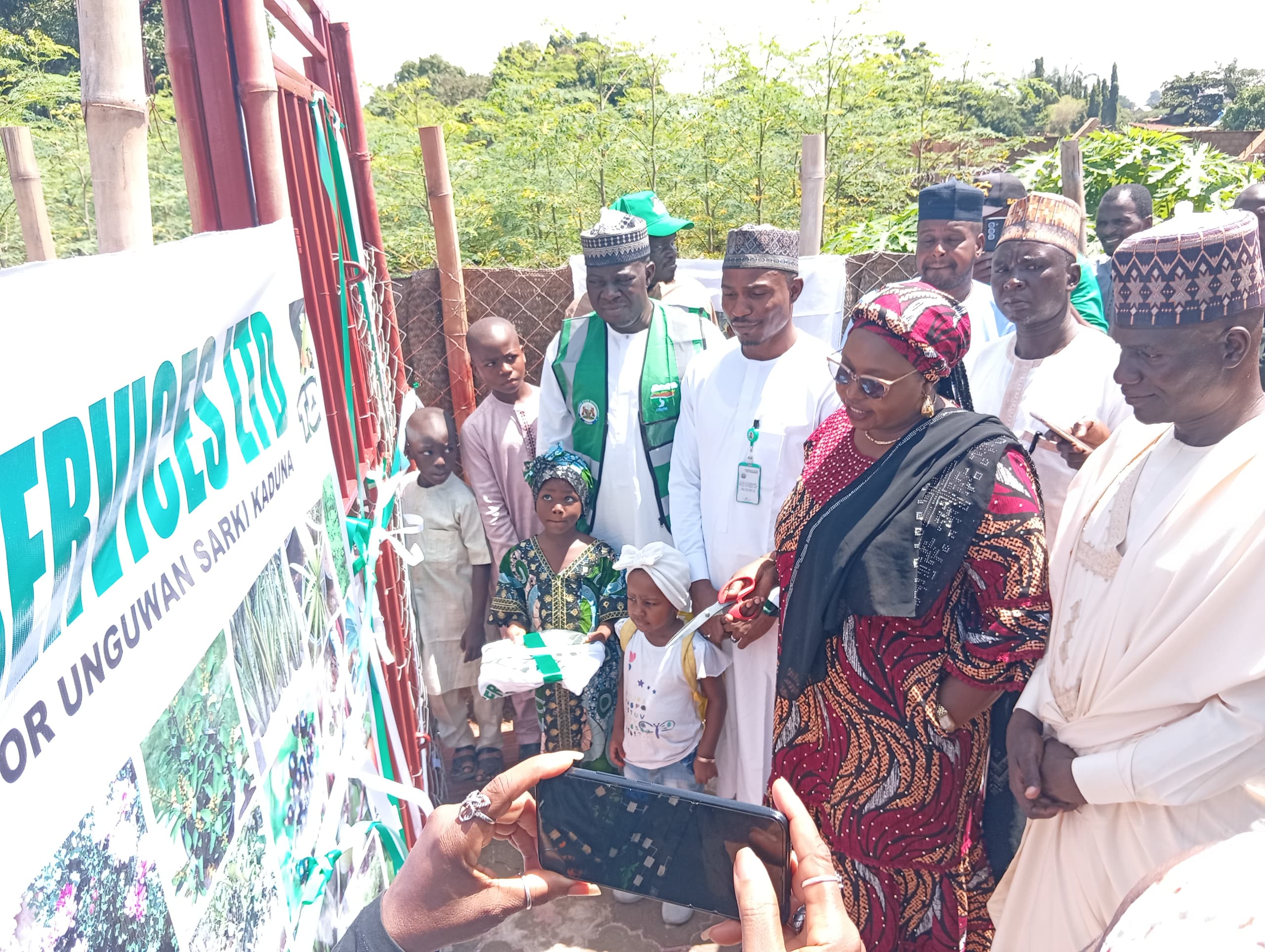
The initiatives were unveiled on Tuesday at Teku Farms International and Agro Allied Services Limited, the state’s seedling supply partner. The event also featured the commissioning of the farm’s agricultural training centre designed to equip women and young people with modern farming skills.
Permanent Secretary, Ministry of Environment and Natural Resources, Linda Yakubu, said the partnership was consistent with the objectives of the Agro-Climatic Resilience in Semi-Arid Landscapes (ACReSAL) project, particularly its focus on climate mitigation and resilience.
Yakubu explained that schools and institutions were deliberately prioritised in the seedling distribution because they had better capacity to nurture the trees to maturity and improve their chances of survival.
She urged the Ministry of Education to take advantage of the current batch of seedlings by collecting and distributing them to schools and other institutions across the state.
According to her, environmental sustainability must begin with children, stressing the importance of exposing pupils to agriculture, horticulture and environmental conservation from an early age.
She described Teku Farms’ agricultural training initiative as a “very noble idea”, noting that early exposure to nature and environmental practices would help young people understand the implications of climate change and become better stewards of the environment.
Yakubu disclosed that the Ministry of Environment, Ministry of Housing and the Kaduna State Urban Planning and Development Authority (KASUPDA) would jointly enforce the requirement for green areas in the approval of new buildings.
She also extended the tree-planting campaign to households, urging residents to plant at least one tree around their homes.
The Permanent Secretary said the state had previously established nurseries and distributed seedlings to schools, worship centres, communities and households, with additional support from the ACReSAL project.
She called for an end to indiscriminate tree felling, saying officials of the ministry had been directed to intervene where necessary.
“Mitigating climate change is basically nature-based, and nature has provided. One of the best ways is to plant trees,” she said.
Also speaking, Founder and Proprietor of Teku Farms International and Agro Allied Services Limited, Mallam Ibrahim Salisu, said the newly established agricultural training centre was created to provide women and young people with practical knowledge of modern farming.
He said the initiative was aimed at creating employment opportunities, improving food production and encouraging young people to view agriculture as a viable business rather than merely subsistence farming.
Salisu said the training programme would expose participants to modern agricultural techniques capable of increasing yields and generating income from relatively small parcels of land.
A coordinator at the farm said the slow adoption of technology had constrained the agricultural sector despite its enormous potential to create jobs and support economic growth.
He noted that generations of Nigerians had relied heavily on traditional farming tools, adding that modern techniques could transform agriculture into a profitable and sustainable enterprise.
The organisers said the initiative was particularly important against the backdrop of rising youth unemployment, arguing that government alone could not absorb the growing number of graduates entering the labour market annually.
They encouraged young people to explore agriculture as an alternative pathway to economic independence while government and other stakeholders provide the necessary enabling environment.
“Agriculture, when properly modernised and supported, can become a powerful tool for employment, economic empowerment and sustainable development for women and young people,” the farm stated.
Stakeholders at the event described the initiative as timely, stressing that greater participation of women and young people would be crucial to transforming agriculture from subsistence production into a modern agribusiness sector.
The training centre is expected to organise regular practical programmes and provide support to participants seeking to establish their own farms.