By Kenneth Orusi, Managing Editor
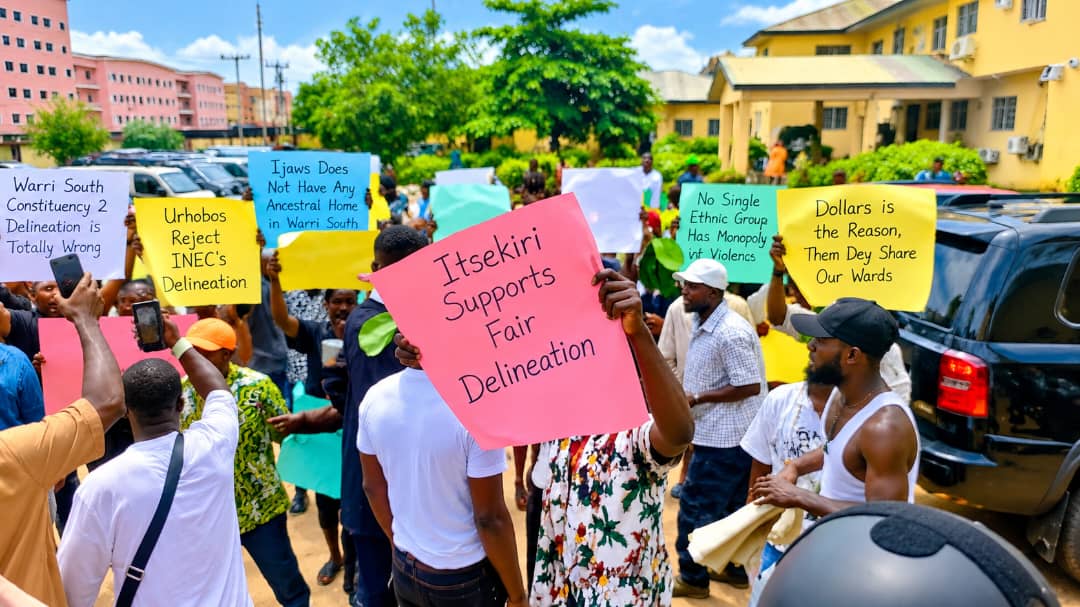
Tension enveloped the Delta State headquarters of the Independent National Electoral Commission (INEC) on Wednesday, November 4, 2026, as aggrieved youths from Warri South Local Government Area stormed the commission’s premises to protest the controversial delineation of electoral wards in the area.
The demonstration, which earlier disrupted an enlarged stakeholders’ engagement on the forthcoming general elections, created a tense atmosphere, with political stakeholders and other participants said to have scampered for safety amid fears of possible violence.
The protesters, who expressed strong opposition to the delineation of Warri South Constituency II, accused INEC of undertaking an exercise they considered unacceptable and inimical to the historical and political interests of their communities.
Their grievances centred on competing ethnic, ancestral and territorial claims, as well as concerns over the criteria adopted by the electoral commission in determining the proposed electoral boundaries.
Some of the placards displayed during the protest carried inscriptions such as: “Ijaws Does Not Have Any Ancestral Home in Warri South”; “No Single Ethnic Group Has Monopoly of Violence”; “Urhobos of Warri Reject INEC’s Warri South Delineation”; and “Warri South Constituency II Delineation Is Totally Wrong.”
The demonstrators also chanted a song alleging that the delineation was being driven by financial inducement, with the refrain, “Because of dollars, them dey share our wards,” suggesting that electoral wards were being distributed for monetary considerations.
However, the allegation of financial inducement was not independently substantiated as of press time.
The protest further exposed the depth of disagreement among communities over electoral representation in Warri South, an issue that has continued to generate heated reactions across ethnic and political divides.
Protest Disrupts Stakeholders’ Engagement
The situation reportedly escalated when some demonstrators allegedly gained access to the venue of the stakeholders’ engagement and chained the entrance doors, leaving participants inside as participants ran for safety through the backdoor.
The development reportedly heightened anxiety among those attending the meeting, until heavily built security operatives intervened and forced the protesters out of the venue.
The incident raised fresh concerns about the security implications of the controversy, particularly as the dispute involves sensitive ethnic and territorial interests.
REC Appeals for Restraint, Requests Formal Complaints
Addressing the protesters, the Delta State Resident Electoral Commissioner, Sir Etekamba Udo Umoren, acknowledged their right to peaceful protest but cautioned against actions capable of undermining public safety and disrupting lawful activities.
Umoren urged the demonstrators to formally document their grievances and submit them through the appropriate channels for consideration and possible transmission to INEC’s national headquarters.
He stressed the importance of peaceful engagement, noting that complaints must be properly documented and presented to enable the commission to examine the issues and take appropriate steps.
The REC warned against violence, particularly the indiscriminate throwing of stones, observing that such actions could endanger innocent persons, including traders and other members of the public who might be caught in the disturbance.
He maintained that peaceful dialogue and the presentation of official complaints remained the appropriate way to address disagreements with the commission.
INEC Under Pressure to Clarify Delineation Process
The latest protest places INEC under renewed pressure to demonstrate transparency and provide convincing explanations about the disputed delineation exercise.
Given the sensitive nature of the controversy, the commission must ensure that its decisions are supported by verifiable records, clearly defined criteria and a process that accommodates legitimate concerns from all affected communities.
While no ethnic group should be allowed to appropriate electoral territories through intimidation or violence, neither should the legitimate concerns of any community be dismissed without proper consideration.
The controversy also demands responsible leadership from political and community stakeholders, particularly at a time when ethnic suspicion and competing claims could easily undermine peaceful coexistence.
INEC must rise above political and ethnic pressures by providing credible answers to the questions surrounding the exercise.
Ultimately, electoral boundaries should be determined by law, verifiable evidence and established procedures, not by the loudest voices, financial influence or the threat of violence.
As the controversy deepens, the commission’s handling of the dispute will be a major test of its neutrality, institutional credibility and commitment to electoral justice in Delta State.