By Abdullahi Alhassan, Kaduna
The Nigerian Society of Engineers (NSE), Kaduna Branch, has called on governments at all levels to stop politicising infrastructure development, insisting that professional engineering expertise, public needs and accountability must take precedence in the planning and execution of projects.
The society also raised concerns over Nigeria’s poor maintenance culture, abandoned public projects, questionable procurement practices and the exclusion of qualified engineers from critical infrastructure decisions.
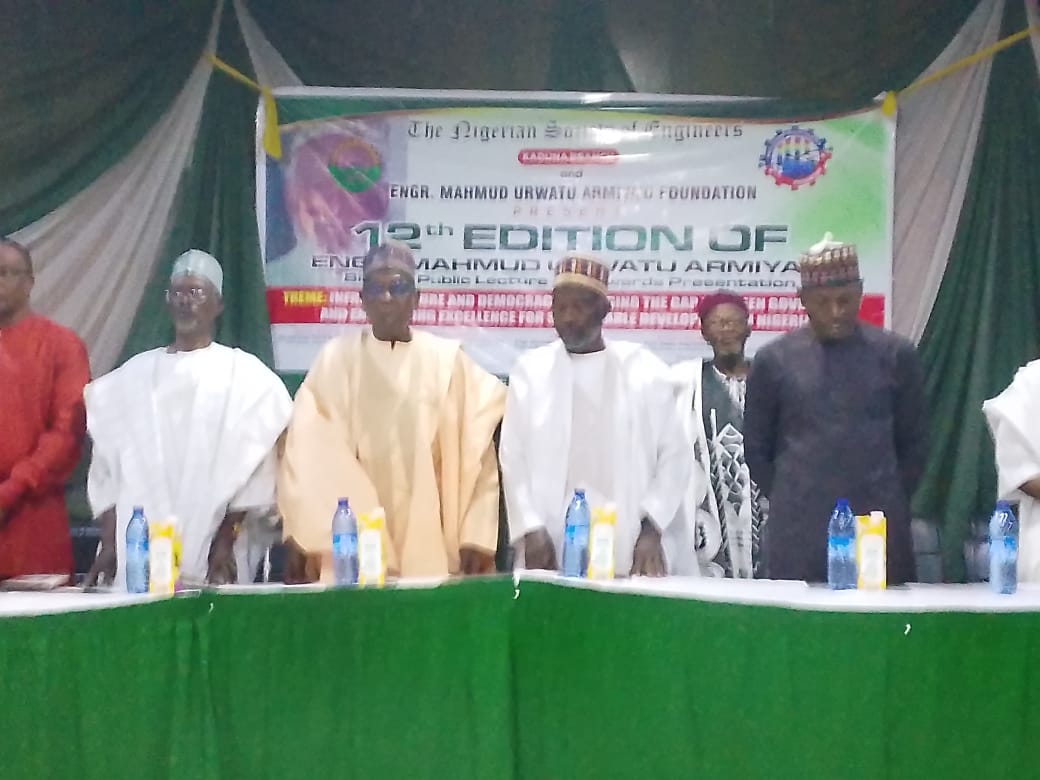
The position was made known at the weekend in Kaduna during the 12th Engineer Mahmud Urwatu Armaya’u Biennial Public Lecture and Awards, organised by the NSE Kaduna Branch in collaboration with the Armaya’u Foundation.
Delivering the keynote address, Engr. Abdul Audu of Kaduna Polytechnic stressed the need for engineering professionals to be involved in infrastructure planning from the conceptual stage, rather than being brought in after political considerations and procurement decisions have already determined the direction of projects.
Speaking on the theme, “Infrastructure and Democracy: Bridging the Gap Between Government and Engineering Excellence for Sustainable Development in Nigeria,” Audu maintained that democratic governance must translate into tangible improvements in the living conditions of citizens through functional roads, reliable electricity, potable water, quality education and accessible healthcare.
He regretted that several government projects were conceived and executed without adequate consultation with host communities or proper assessment of their actual needs.
The engineer particularly criticised the implementation of constituency projects driven by personal and financial interests rather than genuine development priorities, warning that such an approach often results in abandoned projects and facilities that fail to serve their intended beneficiaries.
Audu also condemned the practice of successive administrations abandoning inherited projects to embark on new ones without adequately considering available funding, completion timelines and technical capacity.
He described the situation as a major contributor to the proliferation of abandoned and underutilised infrastructure across the country.
Citing a 2025 World Bank review, the keynote speaker disclosed that Nigeria’s infrastructure stock stood at approximately 35 per cent of its Gross Domestic Product (GDP), significantly below the global benchmark of about 70 per cent.
He argued that bridging the infrastructure deficit required more than increased budgetary allocations, noting that transparency, sound project selection, effective procurement, quality construction and sustainable maintenance were equally critical.
On public procurement, Audu expressed concern over alleged manipulation of bidding processes and selective tendering, which he said undermine competition, compromise standards and deprive the country of value for money.
He consequently advocated stronger collaboration between the Nigerian Society of Engineers and the Council for the Regulation of Engineering in Nigeria (COREN), urging governments to involve both institutions in project planning, technical assessments and implementation oversight.
According to him, proper engineering assessments, including soil testing, terrain evaluation and environmental considerations, should determine project designs and construction methods.
Using road construction as an example, he cautioned against adopting uniform engineering solutions across different geographical locations without considering variations in soil composition, climatic conditions and maintenance requirements.
He observed that road infrastructure in northern Nigeria could require different technical approaches from those suitable for the southern part of the country.
Audu also recalled leading a technical team to assess the Kaduna Refinery in 2017, stressing that the experience demonstrated the importance of engaging qualified specialists in evaluating and managing complex industrial infrastructure.
On infrastructure sustainability, he lamented Nigeria’s persistent neglect of maintenance, observing that governments often prioritise the construction and commissioning of new projects while existing facilities deteriorate due to inadequate maintenance budgets.
He maintained that maintenance planning should be incorporated into project design and government budgeting to guarantee the long-term functionality of public infrastructure.
The keynote speaker further highlighted the economic difficulties confronting construction companies, particularly the impact of fuel subsidy removal and foreign exchange fluctuations on diesel prices, imported equipment and other essential construction materials.
He noted that rising operational costs had increased pressure on contractors, slowed project execution and made appropriate cost reviews and contract variations necessary to sustain ongoing projects.
Earlier, the Chairman of NSE Kaduna Branch, Engr. Ibrahim Bello, explained that the Armaya’u Foundation was established to promote engineering research, provide educational support to academically gifted but financially disadvantaged students and recognise outstanding academic performance.
He appealed to stakeholders and well-meaning Nigerians to support the foundation’s efforts towards establishing a permanent secretariat to strengthen its operations and expand its interventions.
Also speaking, the Chairman of the Foundation’s Board of Trustees, Engr. Abubakar Lawal Yar’adua, popularly known as Jakadan Katsina, expressed concern over the collapse of Nigeria’s refineries and textile industries.
He urged young engineers to become more actively involved in politics and governance, arguing that professional participation in the political process was necessary to influence policies and address the country’s developmental challenges.
The event featured the presentation of awards to outstanding engineering students from universities and polytechnics in recognition of their academic achievements.
Participants at the lecture reiterated the need for stronger collaboration among government institutions, engineering professionals and citizens to ensure that infrastructure development is guided by technical competence, transparency and public interest.
They maintained that Nigeria’s development aspirations could only be realised when infrastructure projects are conceived, executed and maintained to meet the genuine needs of the people rather than short-term political interests.