By Abdullahi Alhassan, Kaduna
For many young women in Kaduna, marriage has often marked the point at which formal education comes to an abrupt end. A new initiative, however, is seeking to challenge that pattern by creating a practical route for married women and young mothers to return to the classroom.
The Rebound Initiative for Young Women is providing flexible learning opportunities for women aged between 15 and 30 who discontinued their education, offering them free learning materials and an opportunity to reconnect with formal education.
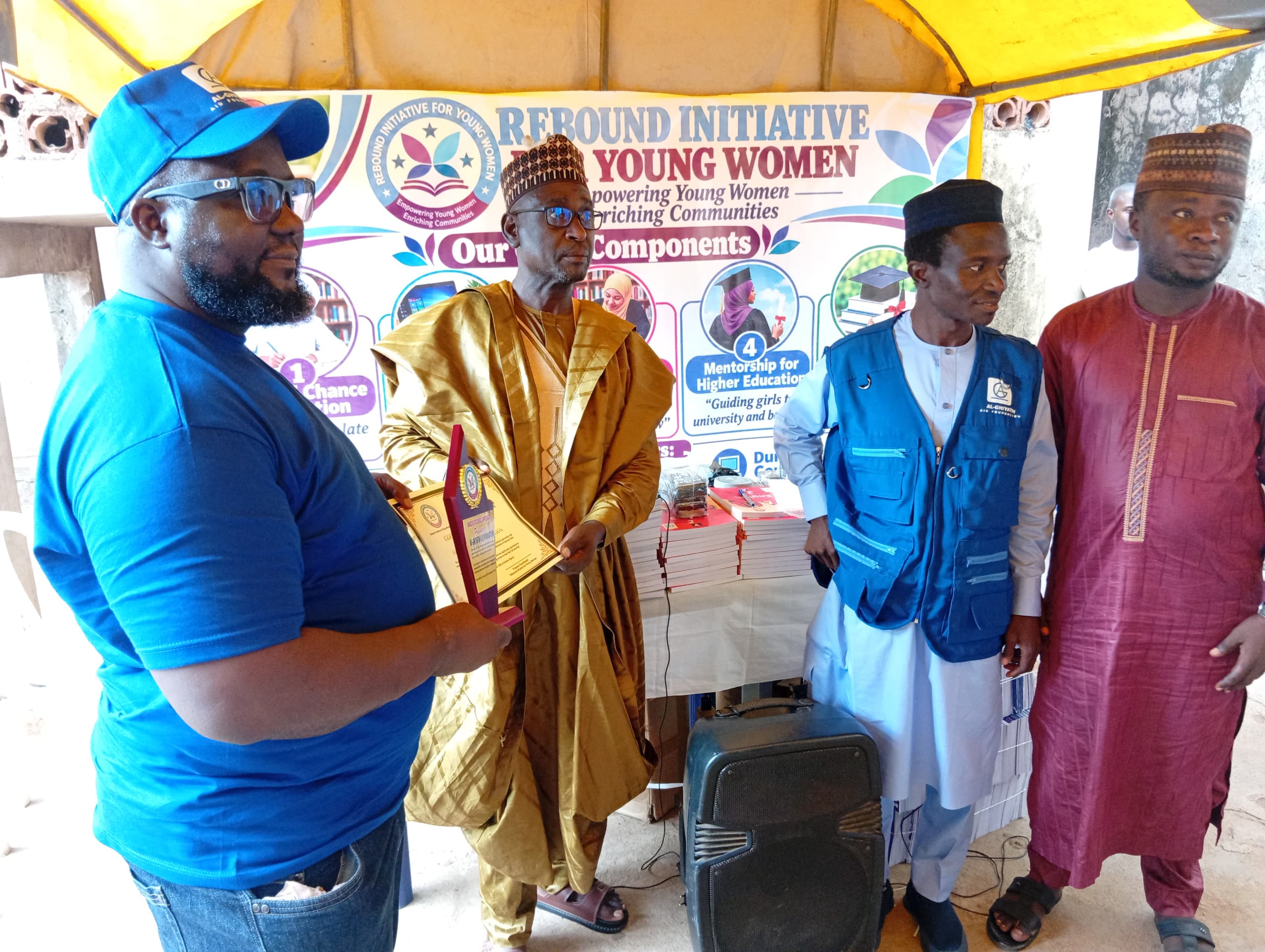
The programme recently received support from the Al-Ghiyath Aid Foundation, established by Mariya Aliko Dangote, which donated textbooks, writing materials and biros to 90 beneficiaries at one of the initiative’s learning centres.
The intervention represents the foundation’s first major donation since its registration.
FAP Model Targets Barriers to Education
According to the organisers, the programme is built around three major obstacles that prevent married women and young mothers from returning to school — time, cost and distance.
The approach, known as the FAP model, combines Flexible learning, Affordable education and Proximity.
Under the arrangement, beneficiaries attend classes for about three hours, two or three times a week, allowing them to combine education with family responsibilities.
The programme also provides tuition-free learning and educational materials, while learning centres are established within communities to reduce transportation costs and make attendance more convenient.
Chairman of the Rebound Initiative, Mallam Musa Abdullahi, said the programme was established to challenge social expectations that limit women to domestic responsibilities.
He said many women who left school after marriage possess the ability to excel academically but lack the opportunity and support required to continue their education.
«“We are fully aware that one of the challenges our society is facing is the social norm that says women should only belong to the kitchen,” Abdullahi said.»
He added that providing women with access to education could unlock their potential and create opportunities for greater independence.
Al-Ghiyath Foundation Makes First Major Intervention
The partnership between Rebound and the Al-Ghiyath Aid Foundation, according to Abdullahi, developed after the initiative approached the foundation for assistance.
He said the foundation responded promptly to the request and provided the educational materials distributed to the beneficiaries.
Ibrahim Mamman Sani, a pioneer member of the foundation and staff member of Dangote Sugar Refinery, said the intervention falls under the organisation’s education and empowerment programme.
Sani explained that the foundation intends to focus its activities on four major areas: basic needs, medical assistance, education and empowerment, and community support for vulnerable groups, including orphans and widows.
He said the education component would particularly focus on girls’ education and skills acquisition that could help beneficiaries become economically independent.
According to him, the foundation’s intervention was motivated by the desire to give back to society and extend opportunities to people who may otherwise struggle to access them.
Foundation Emphasises Sustainability
Sani said the organisation was established with sustainability and continuity in mind, stressing that its interventions would not be limited to one-off donations.
He said the foundation plans to expand its activities across its four focus areas in the coming months.
He also disclosed that the foundation had recently completed the process of opening its corporate account, enabling it to process the donation to the Rebound Initiative.
From Classroom to Skills Acquisition
Rebound organisers said the programme extends beyond basic education.
Beginning in January, beneficiaries are expected to undergo three months of basic computer training before proceeding to vocational skills such as knitting, weaving and pomade production.
Graduates are expected to receive starter tools to enable them to put their newly acquired skills into practice.
The initiative also plans to create a pathway for beneficiaries seeking further academic qualifications.
According to Abdullahi, Rebound has established partnerships with institutions, including satellite centres of Kaduna State University, to facilitate access to diploma and NCE programmes.
He said the ultimate objective was to equip beneficiaries with sufficient education and skills to enable them to become self-reliant.
«“We are not just giving second-chance education,” Abdullahi said. “Our target is that after knowledge and skills, she will continue to go to school from her pocket. She wouldn’t rely on husband or any sponsor.”»
Beneficiaries Welcome Support
For the beneficiaries, the donation has provided an immediate boost to their learning experience.
One of the students, Maimuna Rabiu, said the books would enable her to revise lessons at home and retain what she learns in class.
She expressed appreciation to the organisations for supporting the programme and providing materials that would make learning easier.
The organisers appealed for continued support from individuals, institutions and development organisations to enable the initiative reach more women who have been forced to discontinue their education.
With its flexible learning structure, skills component and planned pathway to higher education, the Rebound Initiative is seeking to turn second-chance education into a route towards greater knowledge, skills and economic independence for young women in Kaduna.