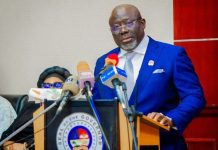

Senator Ned Nwoko’s legislative push to upgrade the Federal College of Education (Technical), Asaba, into the Federal University of Technology, Asaba, represents a bold and strategic initiative poised to reshape the educational and economic trajectory of Delta State and the surrounding South-South region.
This transformative proposal addresses urgent gaps in Nigeria’s technological education infrastructure, while simultaneously laying the groundwork for job creation, innovation, and regional development.
Bridging the Technological Education Deficit
Since its establishment in 1987, the Federal College of Education (Technical), Asaba, has played a pivotal role in producing qualified technical educators. However, its current structure constrains its ability to offer advanced research programs and cutting-edge technological training.
Senator Nwoko’s initiative seeks to reposition the institution as a full-fledged Federal University of Technology, expanding its academic capacity to include programs in engineering, computer science, artificial intelligence, cybersecurity, robotics, and renewable energy.
This transition aligns with the national objective to diversify the economy away from oil dependence by fostering a new generation of skilled professionals in STEM (Science, Technology, Engineering, and Mathematics) fields.
The proposed university would become a nucleus for high-impact research and specialized training, equipping Nigerian youths with the tools to thrive in a knowledge-driven global economy.
Economic Stimulus for Asaba and Beyond
The economic implications of this upgrade are equally significant. Establishing a Federal University of Technology in Asaba would create direct employment for academic and non-academic staff while generating indirect opportunities across the real estate, transportation, hospitality, and retail sectors.
An influx of students and professionals would increase demand for services, boost local commerce, and likely trigger infrastructure development across the capital city.
Furthermore, universities often act as engines of innovation. By fostering partnerships with industry players in sectors such as agriculture, manufacturing, ICT, and clean energy, the institution could drive commercial research and support entrepreneurship.
Such collaborations have the potential to transform Asaba into a regional hub for technology and industrial advancement.
Strategic Positioning for Regional Impact
As the administrative capital of Delta State, Asaba offers a strategic location for the envisioned university. Its proximity to industrial and commercial centers such as Onitsha and Port Harcourt enhances the university’s prospects for research collaboration, internship placements, and investment attraction. Importantly, the South-South geopolitical zone currently lacks a dedicated Federal University of Technology.
The proposed institution in Asaba would bridge this gap and address the regional imbalance in access to advanced technological education.
Supporting National Development Goals
Senator Nwoko’s proposal is strongly aligned with Nigeria’s broader development agenda, which prioritizes innovation, digital transformation, and the growth of a knowledge-based economy.
By strengthening the country’s educational foundation in technology, the proposed university will contribute to national efforts aimed at reducing unemployment, increasing technological self-sufficiency, and driving sustainable development.
A Visionary Investment in the Future
Senator Ned Nwoko’s advocacy for the upgrade of FCE (Technical), Asaba, is not merely an educational reform, it is a forward-thinking investment in the socio-economic future of Delta State and Nigeria at large.
By expanding educational access, nurturing talent, and creating a vibrant innovation ecosystem, this initiative stands to catalyze long-term benefits for generations to come.
With the support of federal authorities, industry stakeholders, and the public, the transformation of the Federal College into the Federal University of Technology, Asaba, could serve as a national model for leveraging education to power inclusive growth, innovation, and regional development.