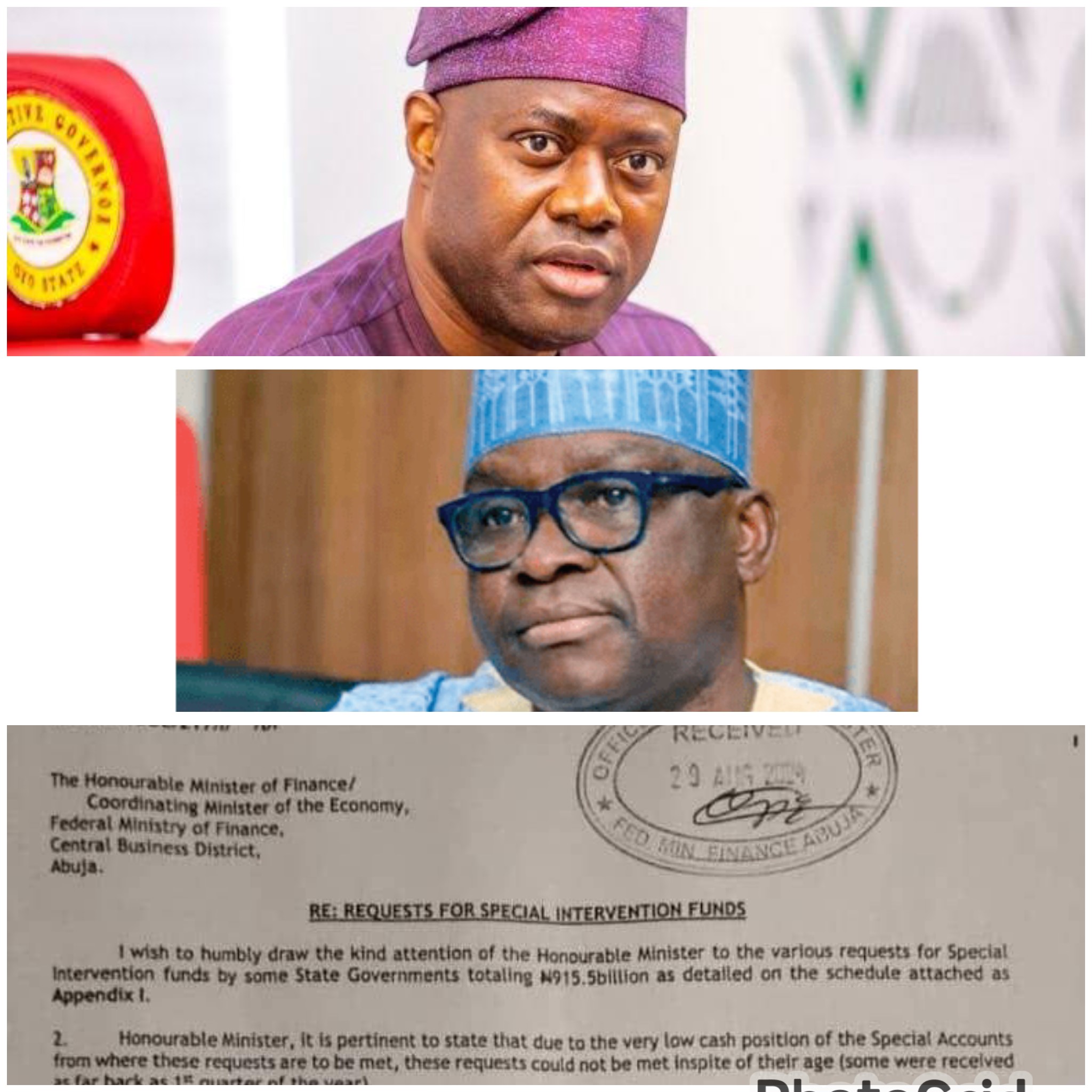
The controversy trailing the funds approved for the reconstruction of communities affected by the Ibadan explosion has deepened, raising serious questions about transparency and accountability in the management of public resources.
Former Ekiti State Governor, Ayodele Fayose, has alleged that the Oyo State Government received ₦50 billion as intervention funds for the Bodija explosion.
However, Oyo State Governor, Seyi Makinde, has consistently maintained that only ₦30 billion was released to the state for the purpose after initial denial.
This leaves a troubling gap of ₦20 billion, which neither side has convincingly accounted for.
Fueling public concern is the document released by Fayose, reportedly from the Office of the Accountant-General of the Federation (OAGF) under the Federal Ministry of Finance.
The document clearly references ₦50 billion as intervention funding for the reconstruction of Old Bodija and surrounding communities affected by the explosion.
While the document establishes the figure associated with Oyo State’s request or approval, it stops short of explicitly stating how much was actually disbursed and when.
This is where the controversy lies.
If ₦50 billion was approved but only ₦30 billion released, Nigerians deserve to know:
Was the remaining ₦20 billion withheld by the Federal Government?
Was it approved in principle but never cash-backed?
Was it released in tranches, with part still pending?
Or was it fully released and subsequently unaccounted for?
On the other hand, if the Oyo State Government indeed received only ₦30 billion, then the Office of the Accountant-General of the Federation and the Federal Ministry of Finance owe the public a clear explanation on the status of the balance.
Silence or vague assurances are insufficient when public funds meant for disaster recovery are involved.
What makes the issue more sensitive is the nature of the funds.
This was not a routine budgetary allocation but an emergency intervention meant to rebuild shattered lives, homes, and livelihoods.
Any lack of clarity around such funds erodes public trust and feeds suspicion, especially at a time when Nigerians are increasingly demanding openness in governance.
At present, the document released by Fayose raises legitimate questions, while the Oyo State Government’s response leaves room for doubt.
Neither side has provided detailed, verifiable financial records such as disbursement schedules, payment advice, or audited statements to conclusively settle the matter.
Between the Oyo State Government and the Office of the Accountant-General of the Federation, one institution or possibly both owe Nigerians a transparent account of what happened to the alleged unaccounted ₦20 billion.
This is not a political issue; it is a public finance issue. Nigerians are not asking for rhetoric or counter-allegations, but for facts supported by documents.
Until a clear explanation is offered, the question remains unavoidable and unresolved: who is with the money?