In a stunning political development, former Vice President of Nigeria and founding member of the People’s Democratic Party (PDP), Atiku Abubakar, has officially resigned from the party, citing irreconcilable differences and a deviation from its founding principles.
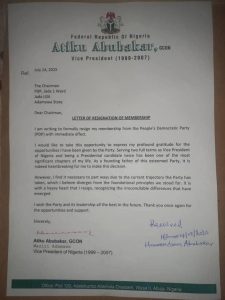
The announcement was contained in a letter dated July 14, 2025, addressed to the Chairman of PDP Ward 1, Jada Local Government Area of Adamawa State.
The letter, bearing Atiku’s signature and letterhead, was formally acknowledged with a “Received” stamp dated July 14, 2025, and signed by a party official identified as HammanDama Abubakar.
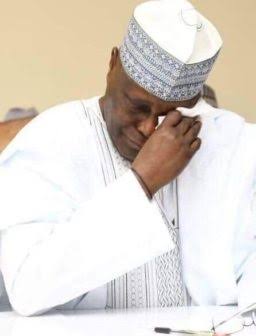
Atiku, who served as Nigeria’s Vice President from 1999 to 2007 under the PDP and was twice the party’s presidential candidate (2019 and 2023), described his decision as “heartbreaking,” adding that it came after deep reflection on the current trajectory of the party.
“I find it necessary to part ways due to the current trajectory the Party has taken, which I believe diverges from the foundational principles we stood for,” Atiku wrote in the letter.
He expressed gratitude for the opportunities afforded to him by the PDP, noting his two-term tenure as Vice President and his role as a prominent figure in the party’s formation and national prominence.
Despite his emotional attachment to the PDP, he said he could no longer ignore the “irreconcilable differences” that have emerged.
The resignation of such a high-profile figure has sent shockwaves through Nigeria’s political landscape, especially as the country begins to shape up for the 2027 general elections.
Atiku’s departure raises urgent questions about the future of opposition unity, the viability of the PDP as a national platform, and whether he will align with another party or float a new political movement.
Political observers have long speculated about Atiku’s dissatisfaction with the PDP leadership, especially after the party’s poor outing in the 2023 elections and internal wrangling over zoning and candidate selection.
However, this formal resignation marks a turning point, confirming his disengagement from the platform he once helped build.
As of press time, the PDP’s national leadership had yet to issue an official response to the development.
Efforts to reach the party’s National Publicity Secretary were unsuccessful.
Analysts anticipate internal crisis talks and possible emergency meetings to address the fallout. Atiku’s next political move remains unclear.
However, given his national influence and political capital, many anticipate that he will remain an active player, either as part of a proposed mega opposition coalition or as a political godfather shaping alliances from behind the scenes.
His resignation could either deepen existing cracks in the PDP or galvanize reformist elements to push for urgent restructuring.
Atiku Abubakar’s exit from the PDP marks a watershed moment in Nigeria’s evolving democratic journey.
Whether it heralds the collapse of a once-dominant opposition force or the birth of a new political chapter for Atiku himself remains to be seen.
What is clear is that the political chessboard has just been dramatically redrawn.
This is a developing story. Stay tuned for more updates.