
In its sustained advocacy for the rights and welfare of Persons with Disabilities (PWDs), TAF Africa has urged the Delta State Government and key stakeholders to fully adopt inclusive education as a cornerstone of disability protection, in line with Nigeria’s National Disability Law of 2018.
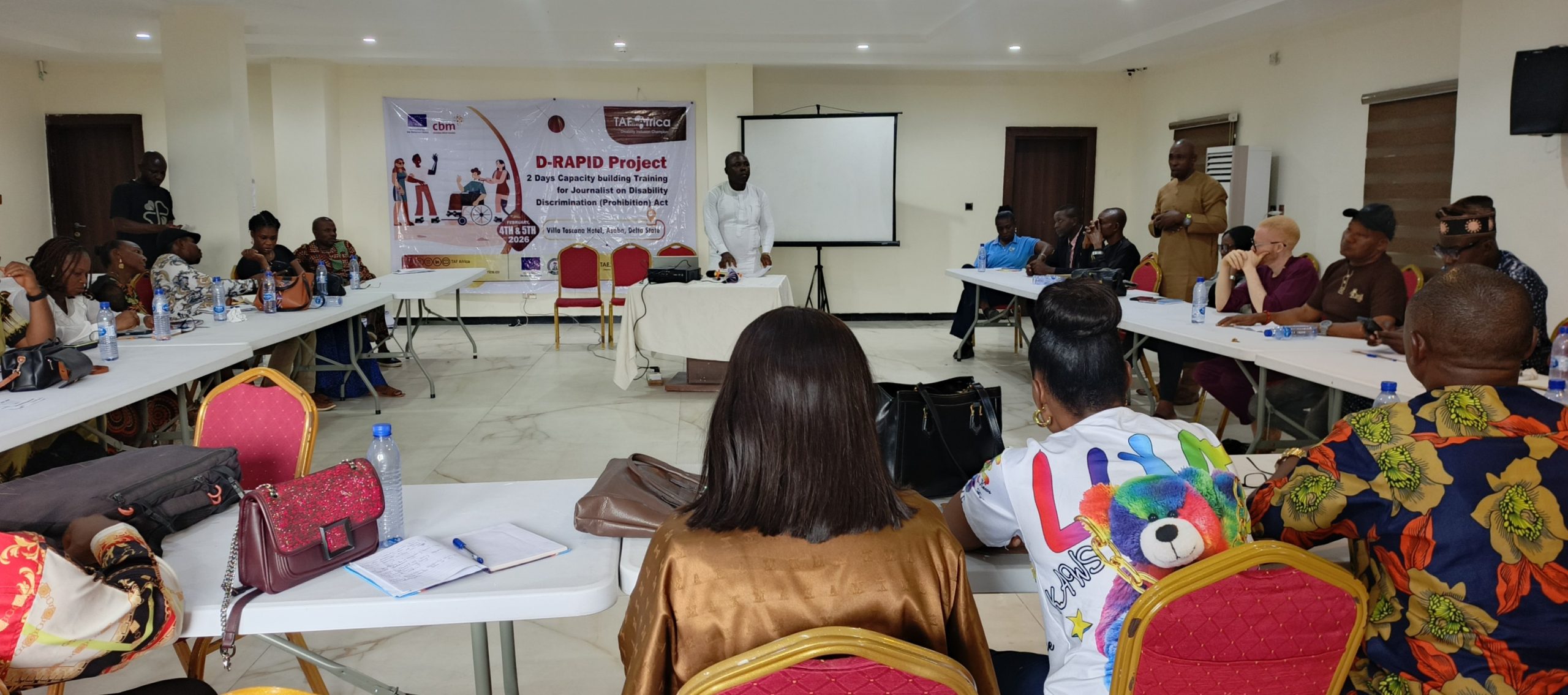
The call was made during a two-day Media Engagement, Advocacy and Journalists’ Training organised by TAF Africa under its D-RAPID Project, held on Thursday, February 5, 2026, at Toscana Hotel, Asaba.
Speaking at the event, the Programme Coordinator, Dr. Andrew Adaji, underscored the importance of integrating persons with disabilities into mainstream education rather than isolating them in separate institutions.
Dr. Adaji noted that the National Disability Law advocates inclusive learning environments, warning that excessive reliance on special schools could reinforce social exclusion and deepen inequality.
While acknowledging the good intentions behind the Delta State Protection of Persons with Disability Law, 2024, he drew attention to Section 15 (Right to Education), Subsection 3, which provides for at least one special public school for persons with disabilities at the primary and secondary levels in each local government area.
According to him, the provision requires careful reassessment to ensure it aligns with internationally accepted standards that prioritise inclusion over segregation.
He emphasized that inclusive education thrives on the availability of well-trained teachers, functional resource centres, and learning materials specifically designed to support students with disabilities.
Beyond education, Dr. Adaji called for broader institutional reforms to improve the quality of life of persons with disabilities.
He stressed the need for accessible healthcare services, including the deployment of sign language interpreters in hospitals, and advocated for disability-friendly infrastructure in public buildings, such as ramps and designated parking spaces.
In a separate session with journalists, Lynn Agwuncha highlighted the strategic role of the media in advancing disability inclusion through the effective use of the Freedom of Information (FOI) Act.
She explained that the 2011 law empowers journalists to demand accountability and obtain data on government compliance with disability-related policies, including employment inclusion and public infrastructure accessibility.
The programme featured an interactive dialogue where participants examined ongoing challenges faced by persons with disabilities and proposed practical solutions.
Among the key resolutions was a call for sustained media advocacy through disability-focused jingles and public awareness campaigns to challenge discrimination and foster positive societal attitudes.