By Kenneth Orusi, Managing Editor
Asaba, April 8, 2026 — The Delta State Government has intensified efforts to resolve persistent electricity challenges with the unveiling of the ambitious “Light Up Delta” initiative, following a strategic meeting convened by Governor Sheriff Oborevwori with energy experts, financial institutions, and key stakeholders at Government House, Asaba.
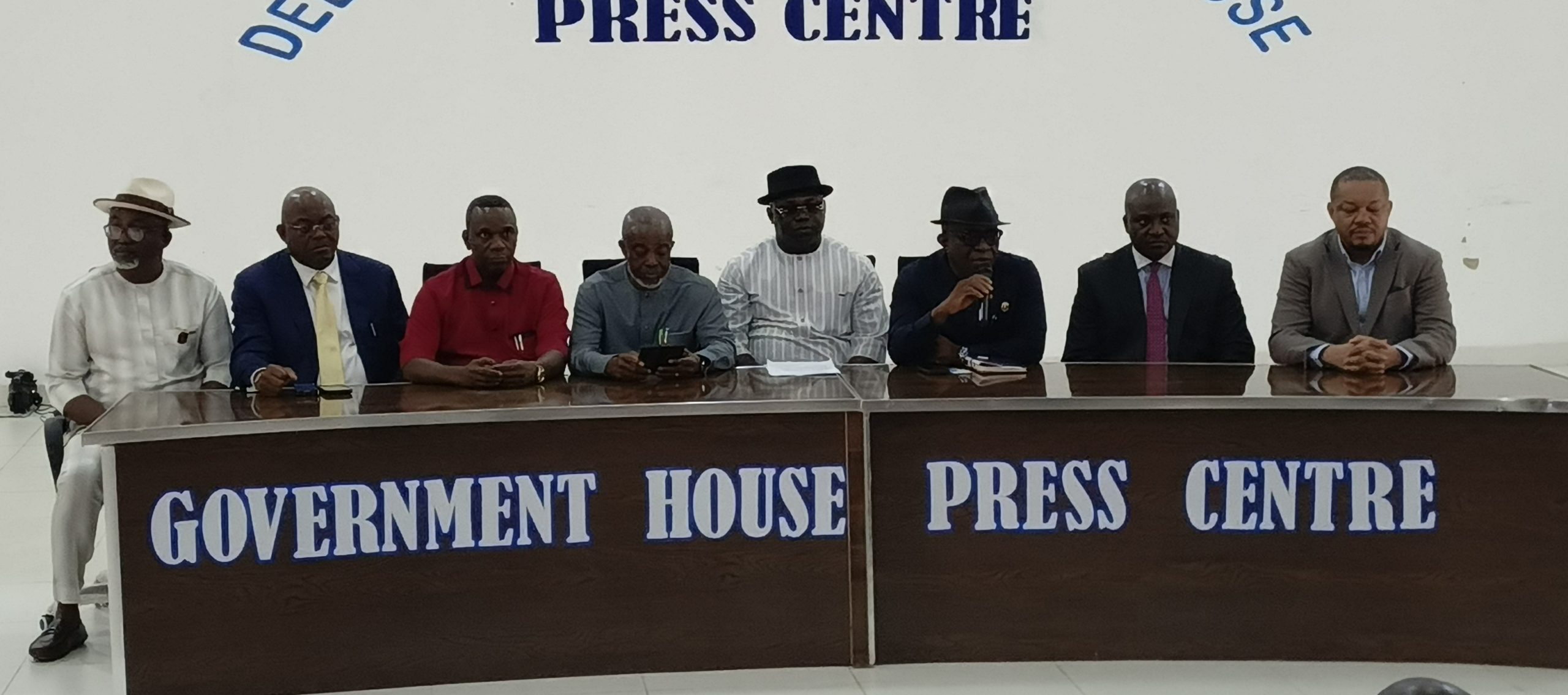
Speaking during a press briefing on Wednesday April 8, 2026, after the meeting, key officials and partners provided detailed insights into the initiative, outlining a coordinated plan to deliver stable, affordable, and round-the-clock electricity across the state.
Commissioner for Economic Planning, Mr. Sunny Ekedayen
“Before today, the governor, in his wisdom, approved the engagement of Ames Consulting Nigeria Limited, a foremost electrical consulting company, to carry out a comprehensive diagnostic assessment of the infrastructure gaps and personnel requirements needed to drive the ‘Light Up Delta’ initiative.”
“This initiative represents a detailed and structured roadmap that will guide the state in addressing electricity challenges holistically. A key component of this plan is the establishment of a State Electricity Commission that will serve as the central coordinating body to drive and sustain the entire process.”
“Electricity services are capital-intensive, but the government is committed to ensuring that tariffs remain among the most competitive in the country, leveraging the state’s existing energy assets.
“Let me assure you that the government is determined to put an end to unreliable electricity and is not taking this issue lightly.”
Commissioner for Energy, Engr. Michael Anoka
“The directive from the government is clear, we are launching the ‘Light Up Delta’ initiative as a strategic tool to drive industrialization across the state. Our focus is to quickly harness the low-hanging opportunities available within our existing power assets.”
“Delta State is already endowed with significant generation capacity in Okpai, Ughelli, and Sapele, where there is considerable stranded power.
“What this means is that our immediate challenge is not generation, but the efficient transmission and distribution of this available power.”
“Our target is to deliver results within the next 12 months, beginning with Asaba and Warri, where we aim to achieve 24-hour electricity supply before scaling to other parts of the state. We are working closely with Power Acumen Consulting to guide and support this process.”
Chief Executive Officer, Power Acumen Consulting Limited, Engr. Matthew Edevbie
“It is a privilege to partner with the Delta State Government on what is clearly a bold and transformative initiative. The ‘Light Up and Industrialise Delta’ programme is an audacious vision designed to position the state as fully open for business.”
“The core objective is to make Delta State a hub of industrialization by ensuring reliable electricity across the entire state, while also making power affordable for industrial and commercial activities.”
“This initiative will commence with strong collaboration with the Benin Electricity Distribution Company to guarantee 24/7 electricity supply in Asaba and Warri. With sustained commitment, we are confident that Delta State will witness significant industrial growth within the next five years.”
Commissioner for Finance, Sir Fidelis Tilije
“We have received interim reports on the initiative and have directed that a comprehensive timeline be developed, incorporating the cost implications of every phase of implementation.”
“While it is premature to state the exact financial outlay at this stage, I can confidently affirm that Delta State has the financial capacity to fund all necessary steps required to achieve electrification and industrialization.”
“The commitment of this administration is clear, we will ensure that adequate resources are made available to fully execute this vision and deliver tangible results for the people of Delta State.”
Lead Partner, Details Commercial Solicitors, Mr. Ayoli Jemide
“For over two decades, we have been involved in advancing industrialization, and one thing is clear—electricity remains the lifeblood of any meaningful development.”
“It is the critical tool that connects economic growth to social equity and long-term environmental sustainability. Without reliable power, it is impossible to achieve sustained progress in any economy.”
“The governor’s decision to fully embrace this initiative is commendable, and we are committed to ensuring that every stage of implementation is closely monitored. Within the first phase of 12 months, Asaba and Warri are expected to achieve uninterrupted power supply.”
Managing Director, Infrastructure Bank Plc, Mr. Erhabor Okogun
“Delta State stands out as a well-managed and financially stable state, and our role is to leverage its existing resources while structuring innovative financing models to support large-scale infrastructure development.”
“We will optimize available capital, attract additional funding, and ensure that multiple projects across the electricity value chain, generation, transmission, and distribution, are executed efficiently and simultaneously.”
“Beyond power, this initiative will stimulate broader economic growth by supporting key industries such as data centers, petrochemicals, and agro-allied businesses.
“It will create jobs, increase internally generated revenue, attract investors, and deliver measurable value to all stakeholders within a short timeframe.”
The “Light Up Delta” initiative represents a bold, coordinated, and well-financed intervention that signals a turning point in Delta State’s development trajectory.
With strong political will from Governor Oborevwori, backed by technical expertise, credible partnerships, and clear implementation timelines, the state is strategically positioned to overcome its long-standing electricity challenges.
The alignment across policy, infrastructure planning, and financing underscores a comprehensive approach that goes beyond rhetoric to actionable results, beginning with the delivery of 24-hour power supply in key urban centres like Asaba and Warri within the first phase.
This deliberate focus on transmission and distribution, rather than generation, reflects a pragmatic understanding of the state’s existing energy advantages.
Ultimately, if executed as outlined, the initiative is poised to unlock industrial growth, attract investments, create jobs, and significantly improve the quality of life for residents.
It sets the stage for Delta State to emerge not just as an energy-stable region, but as a competitive hub for economic expansion and sustainable development in Nigeria.