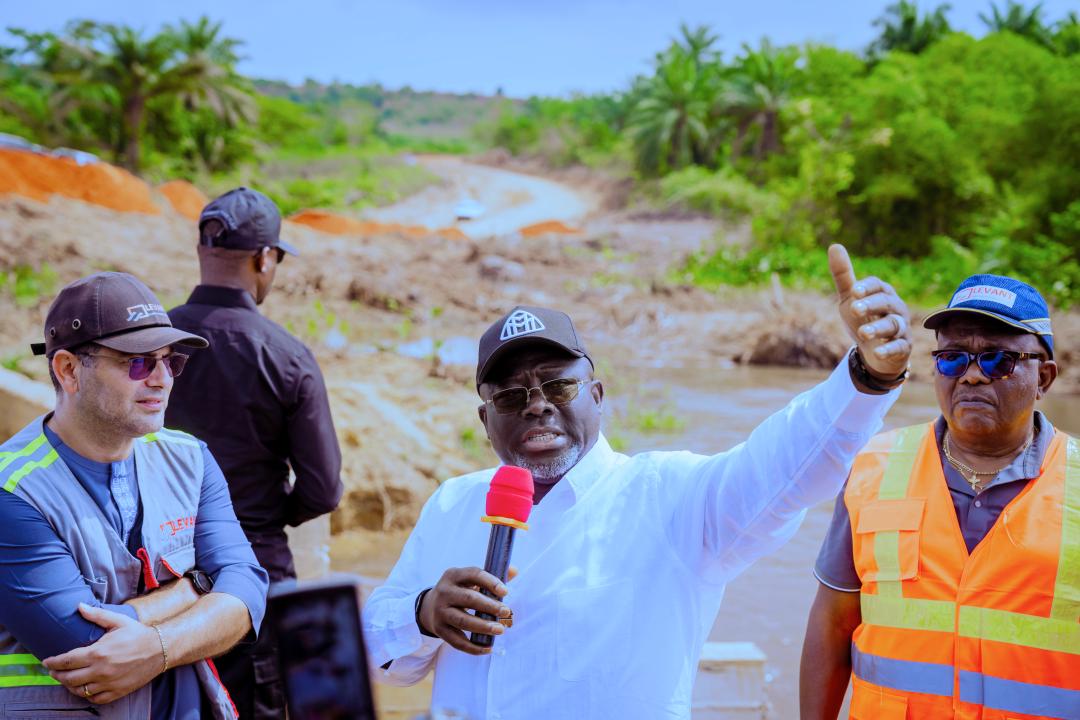
Governor of Delta State, Rt. Hon. Sheriff Oborevwori, has underscored his administration’s zero-tolerance for substandard infrastructure while personally inspecting the ongoing Ugbolu–Okpanam Road and Phase Two of the Oko-Anala–Oko-Ogbele–Oko-Odifili Road projects.
During Tuesday’s inspection, the governor made it clear that the visit went beyond routine supervision, stressing that on-site verification remains a critical tool for ensuring accountability and delivery.
“I did not just come here casually; I came to personally inspect and see for myself the level of work,” Oborevwori stated, noting that effective governance requires continuous follow-up beyond groundbreaking and commissioning ceremonies.
Drainage Deficiencies Under the Spotlight
At the 12.12-kilometre Ugbolu–Okpanam Road project, the governor drew particular attention to what he described as longstanding drainage inadequacies that had worsened flooding in the corridor.
He explained that earlier drainage designs in the area, often single or double channels, were structurally insufficient to manage the heavy volume of stormwater generated by the terrain.
“Some of the previous drain systems were either single or double but not adequate to handle the volume of water.
“We are ensuring that this drainage infrastructure is comprehensive and durable. Residents will notice the difference during the rainy season,” he said.
To correct the challenge, the project now features expansive concrete drainage channels measuring about 7.7 metres wide on both sides of the road, alongside an approximately 11-metre total road width and an 8-metre main carriageway.
The governor noted that Okpanam’s higher elevation naturally channels large volumes of runoff into adjoining lower areas, a geographic reality that informed the state’s decision to prioritise robust flood-control engineering capable of safely directing water to the river.
Strategic Corridor for Connectivity
Oborevwori described the Ugbolu–Okpanam Road as a critical link expected to stimulate mobility, commerce, and social integration between the two communities and adjoining urban corridors.
He added that the project reflects the administration’s broader policy of balanced infrastructure distribution across both urban and rural areas.
“We are not only constructing flyovers and roads in urban centres; we are also extending infrastructure to rural communities. Development must be balanced,” the governor affirmed.
Firm Stance on Oko Road Timeline
At the Phase Two site of the Oko-Anala–Oko-Ogbele–Oko-Odifili Road, the governor again struck a firm tone, insisting on accelerated progress and strict adherence to quality standards.
He disclosed that Phase One, covering about 4.7 kilometres, has been completed, while the remaining five-kilometre stretch presents significant engineering challenges due to the prevalence of weak clay subsoil.
“If you do not properly remove unsuitable soil and stabilise the base before filling, the road will not last,” he warned, emphasizing the administration’s insistence on proper foundational work.
The governor revealed that the contractor’s initial completion projection of August 2027 was unacceptable, directing that work be intensified for delivery by the end of this year or early next year.
Oborevwori assured residents that the state government has fully mobilised the contractor and provided the necessary funding, stressing that delays would not be attributed to financing constraints.
In a pointed message to contractors handling state projects, the governor declared that future opportunities would depend strictly on performance.
“If contractors want more jobs from this administration, they must deliver quality work and complete projects on time,” he said.
Reaffirming his administration’s infrastructure philosophy, Oborevwori concluded: “We believe in standards, and we will not compromise on quality.”